 WORLD NEWS VIEW
India’s September inflation reaches 5.54%: food prices and RBI outlook explained
The September 2026 retail inflation rate of 5.54% and food inflation of 7.74% raise questions about household costs and the RBI’s future rate decisions.
The facts below are reported as of 13 October 2026; source event dates may be earlier.
India's headline retail inflation reached 5.54 percent in September 2026, according to data reported on October 12. The figure approached the Reserve Bank of India's upper tolerance limit of 6 percent and renewed debate about how long borrowing costs may remain high. Food-price pressure was a central part of the story, with food inflation reported at 7.74 percent. For households, this is not merely a technical economic number. It raises practical questions about grocery bills, budgets, savings and loans. Yet the headline rate is a nationwide index, not a claim that every product rose exactly 5.54 percent or that every family's costs changed identically. Understanding what the statistic captures is the first step toward interpreting the latest data accurately.
What the October 12 release revealed
Reuters reported that the September consumer-price inflation reading rose to 5.54 percent year on year. The agency's account described it as the fourth consecutive month above the RBI's medium-term 4 percent target. Food inflation was especially elevated. The number was reported after September ended, so the information became public in October. That difference matters for a site publishing an October 13 explainer: the event being analyzed is September price behavior, not an overnight announcement that all prices suddenly jumped on October 13. Comparisons with the same month a year earlier are built into an annual inflation rate, which means the previous year's price level also affects the percentage.
What consumer-price inflation measures
The consumer-price index tracks the cost of a representative basket of items and services over time. Rather than following only tomatoes, fuel or rent, it combines many categories with weights intended to represent typical consumption. The reported inflation percentage indicates how that index compares with the relevant earlier period. It does not say that 5.54 percent of the population experienced inflation or that one particular item costs 5.54 percent more every month. Prices can differ between neighborhoods, seasons and families. If one household spends an unusually large share of income on vegetables, its experience can diverge substantially from the national measure even while the index itself is calculated correctly.
Why food prices draw particular attention
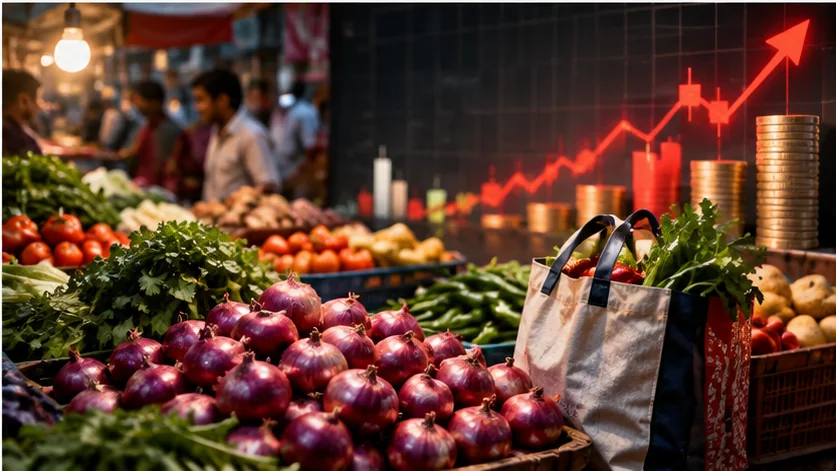
Food items are purchased frequently and changes are visible at the shop counter. Reuters' October 12 reporting identified food inflation of 7.74 percent as a major contributor to the broader acceleration. Its account cited pressure involving everyday essentials including onions and garlic. A high food figure does not imply every vegetable has the same increase, nor does it prove every retail market changed simultaneously. Supply conditions, seasonal availability, transport costs and the comparison month affect individual prices. For a household with a fixed monthly income, rising grocery expenses leave less room for discretionary spending. That immediate strain is one reason food inflation dominates public conversation even when economists emphasize the wider consumer basket.
Why the RBI watches both the target and the range
India's monetary-policy framework uses a medium-term inflation target of 4 percent with a tolerance band from 2 to 6 percent. A reading of 5.54 percent is below the top of that band but above the target's midpoint. These facts should not be collapsed into a simplistic statement that inflation is either fully controlled or legally out of range. The central bank looks at current prices, expected inflation, growth conditions and financial stability when setting policy. A rise near the upper boundary may strengthen expectations of tighter policy, but it does not mechanically determine the precise date or size of the next rate decision. Central banks must judge both the persistence and the sources of price pressure.
What analysts expect, and what is not yet decided
Financial-market economists quoted in Reuters reporting anticipated the possibility of additional rate increases after the September data. Some forecasts discussed two further quarter-percentage-point steps by early 2027. Those are forecasts from analysts, not a confirmed RBI announcement or a promise that borrowing costs will definitely rise on particular dates. Different economists can reach different expectations using the same publicly available numbers because they make different assumptions about food, energy, currency movements and growth. For readers, the important distinction is between an observed inflation rate, a central-bank policy decision already taken and a forecast about possible future action. Headlines often mix those categories and make uncertainty harder to see.
How the October repo-rate decision fits the story
The October data arrived after an earlier RBI policy decision had already changed the benchmark repo rate, according to contemporary financial reporting. The repo rate influences the cost of money in the banking system, although the effect on each home loan or personal loan depends on its contract and the lender's transmission policy. It would be inaccurate to say that the September inflation number caused a decision made before the number's public release. What it can do is alter expectations for subsequent decisions. Readers following WNV's earlier article on the October repo rate should treat this new piece as a separate update: new data have become available, while the previous article remains a historical account of what was known at its original publication time.
What higher inflation means for household purchasing power
If take-home income remains unchanged while a family's usual basket becomes more expensive, the household may need to reduce another expense, use savings or change purchasing habits. The strain is uneven because spending patterns are uneven. Food-heavy budgets can feel a sharper squeeze when food prices outpace the average index. Long-term contracts or delayed salary adjustments can make it difficult to respond quickly. On the other hand, not every cost changes at the same moment and some items may fall in price. The responsible interpretation is that the new data suggest pressure on average consumer purchasing power, not that every Indian family experienced the same financial loss or that all living costs rose by an identical amount.
What borrowers should watch next
Borrowers can check whether a loan has a fixed or floating interest rate, which benchmark it is linked to, and when that benchmark is reset. A policy-rate increase may affect floating-rate payments over time, but loan contracts vary. The CPI release itself does not instantly rewrite mortgage agreements. Before making financial decisions, a borrower should consult the lender's actual terms, outstanding balance and reset schedule. People comparing offers should look beyond the advertised initial rate to fees and the risk that repayments change. This article explains economic context; it does not provide individualized investment or lending advice. The sensible action is to understand one's exposure rather than assume a precise future EMI from one macroeconomic headline.
What savers and depositors should understand
Inflation changes the purchasing power of money. A savings balance can grow in nominal terms while its real purchasing power grows more slowly if the interest received does not keep pace with prices. Banks do not necessarily adjust deposit rates at exactly the same time or by the same amount as policy rates. Tax treatment and account terms also affect the effective return. Consequently, the September CPI print may be relevant to savings choices, but it is not enough on its own to rank every deposit or investment product. Readers should compare realistic after-tax terms, accessibility and risk rather than using a single inflation number to make abrupt decisions about money that may be needed for emergencies.
Currency movements and imported inflation
The rupee's exchange rate is another part of the economic backdrop. When the local currency weakens, imports priced in foreign currency can become more expensive in rupee terms, though contracts, hedging and timing shape the eventual retail impact. Fuel and other internationally traded commodities can transmit external price pressures into the domestic economy. Reuters also reported currency-market measures and a rupee rebound around October 12. A stronger day for the currency does not automatically eliminate past inflation or guarantee that future imports will be cheap. The relationship operates through supply chains over time. Inflation and currency headlines should therefore be interpreted together without claiming a one-day market movement fully solves a longer-term price challenge.
What weather and supply conditions contribute
Agricultural output and the movement of food from farms to cities matter greatly for food inflation. Weather events can disrupt harvesting, storage or transport, while shortages in particular products may create sharp local price moves. Analysts also consider international energy costs and import conditions. But assigning a nationwide 5.54-percent headline entirely to a single weather event would go beyond the evidence presented in the cited report. Different components can rise for different reasons. A stronger explanation examines what specific CPI categories changed, how their weights contribute and whether a shift is likely temporary or persistent. Policymakers must distinguish problems monetary policy can influence from supply shortages that require other responses.
Why September inflation is not the same as “prices falling”
When the inflation rate declines, prices in the overall basket are usually still rising, simply more slowly than before. Conversely, a rising inflation rate indicates an acceleration in the measured annual pace, not a claim that no individual product became cheaper. These distinctions help readers understand future reports. If inflation were to fall from 5.54 percent to 5 percent, that would generally describe disinflation, not a reversal of the entire earlier price increase. Families can remain under pressure even as the rate starts to ease because price levels have already moved up. The difference between a price level and its rate of change is one of the most useful tools for interpreting economic headlines.
What the next RBI and inflation releases may clarify
The next consumer-price reading will help show whether September's jump was persistent or affected by short-lived conditions. Further RBI communication may clarify how policymakers interpret food, currency and growth risks. Analysts will also watch the underlying measures that exclude especially volatile components to see whether pressure is spreading more broadly. No single indicator removes uncertainty. Consumers should compare several months and official updates rather than extrapolating from one number. WNV will publish a separate article when a materially new official release or rate decision occurs, preserving this October 13 explainer as a record of the situation and information available at publication.
A practical checklist for readers
Start with the headline rate, then look at food inflation and the categories most relevant to your household. Check whether an interest-rate comment is an actual central-bank announcement or merely an analyst's forecast. Compare prices over several months rather than relying on a viral image of one bill. If you have debt, examine your specific reset terms rather than guessing about automatic changes. If you save regularly, compare nominal returns with inflation and remember taxes and liquidity. Finally, distinguish the release date from the month measured. These steps turn macroeconomic statistics into informed questions without promising that every household can avoid all price pressure.
Frequently asked questions
What was India's September 2026 retail inflation rate?
Reuters reported headline consumer-price inflation of 5.54 percent year on year, with food inflation at 7.74 percent. The figures relate to September and were reported publicly on October 12.
Is 5.54 percent above the RBI's tolerance ceiling?
No. It is below the framework's 6 percent upper tolerance limit but above the 4 percent medium-term target. That distinction matters when discussing the outlook for monetary policy.
Will the RBI definitely raise rates again?
No new rate increase is guaranteed by this data release. Analysts have discussed further hikes as a possibility, but only an actual RBI policy announcement constitutes a decision.
Does a 5.54 percent CPI rise mean every grocery item became 5.54 percent more expensive?
No. CPI is a weighted basket index and components change by different amounts. A household's real spending pattern may produce a noticeably different personal experience.
Should people change loans or investments immediately?
A single reading is not individualized financial advice. Check loan terms, risk, returns, cash needs and further official updates before making consequential decisions.
Sources and verification
Read the original sources to examine the evidence and publication dates.
Related coverage
 AI illustration
D.B. Cooper: the FBI evidence behind America’s 1971 unsolved skyjacking
An evidence-first investigation of the real 1971 D.B. Cooper skyjacking, FBI records, the suspects, the vanished ransom and what remains unknown.
 AI illustration
Dyatlov Pass explained: nine deaths, mountain evidence and the avalanche research
What is documented about the 1959 Dyatlov Pass tragedy, how snow-slab avalanche research works and why unanswered questions remain.
 AI illustration
Antarctic sea ice at third-lowest winter maximum: NASA’s 2026 numbers explained
NASA’s October 12 data show Antarctic winter sea-ice extent peaked at about 17.59 million km² in September 2026. What it means and what it does not.