 WORLD NEWS VIEW
Dyatlov Pass explained: nine deaths, mountain evidence and the avalanche research
What is documented about the 1959 Dyatlov Pass tragedy, how snow-slab avalanche research works and why unanswered questions remain.
The facts below are reported as of 13 October 2026; source event dates may be earlier.
Nine experienced hikers died during a winter expedition in Russia's northern Ural Mountains in 1959. The incident became famous not only because of the deaths but because aspects of the recovered scene seemed difficult to reconcile with an ordinary mountain accident. Over decades, popular retellings added secret experiments, unknown creatures and supernatural explanations. The documented record is far more sobering. Researchers have examined how conditions around the expedition's tent could produce a rare snow-slab avalanche and how such a mechanism might account for several troubling observations. That research offers a credible explanation, not a license to pretend every question about the night has been conclusively answered.
The expedition and its real human cost
The group was led by Igor Dyatlov, and the pass later took his name. The travelers were experienced, not tourists unaware of winter conditions. They set out on a demanding journey across remote, wind-exposed terrain at a time when forecasts, communications and rescue support were much more limited than those available to many travelers today. The tragedy has often been packaged as an entertaining puzzle, but nine people lost their lives and families waited for answers. The proper starting point is the people and their expedition, not a monster or an imagined government conspiracy. Suspense is legitimate in historical storytelling; inventing a cause or making the dead into characters in an unsupported horror plot is not.
Why the original scene unsettled investigators
Published scientific analyses identify several features that kept the avalanche idea controversial for years. The slope above the tent appeared relatively gentle compared with many avalanche sites. Searchers did not identify obvious traces of an avalanche, and some injuries seemed severe or unusual. Questions also arose about the delay between the group's campsite being established and whatever forced the hikers to leave it. These observations matter because a proposed explanation has to account for contrary evidence, not merely fit the details that favor it. The absence of a conventional large avalanche scar did not prove that no snow movement occurred, but it made any avalanche hypothesis require more careful physical reasoning.
The importance of the 2021 scientific paper
In January 2021, researchers Johan Gaume and Alexander Puzrin published a paper in Communications Earth & Environment examining the mechanisms of slab avalanche release and impact in the Dyatlov Pass incident. They used analytical and numerical modeling to explore whether a relatively small slab of snow could be released after a delay and whether its impact could cause injuries consistent with the documented concerns. Their study did not place a camera at the 1959 campsite or recover a new eyewitness account. Its contribution was a physically plausible mechanism that researchers could evaluate, critique and compare with field conditions. Explaining what a model can and cannot prove is essential to honest reporting of scientific work.
What is a snow-slab avalanche?
A slab avalanche occurs when a relatively cohesive layer of snow moves over a weaker layer beneath it. The size of the moving material, the structure of the snowpack and the shape of the terrain all influence the possible consequences. A slab does not need to look like a spectacular wall of powder in order to be dangerous. People sleeping in a confined position can face impacts and compression that differ from injuries in open terrain. In the Dyatlov research, the relevant question was whether a smaller, less visually obvious movement could strike the tent area under particular conditions. The modeling explored that possibility rather than proposing that a giant visible avalanche swept away an entire mountainside.
Why a delay matters
Many readers imagine an avalanche as an immediate consequence of a disturbance. In reality, snowpack stability can change as wind deposits snow and stresses build over time. The 2021 researchers examined how delayed release could occur under certain combinations of snow structure and wind loading. This matters because the expedition had already established its campsite before the unknown emergency. A theory that requires the tent to be destroyed at the exact moment it was pitched would conflict with that chronology. A delayed mechanism offers a possible bridge, though the exact timing in 1959 cannot be reconstructed to the minute from the surviving record. The model should be understood as a possible process, not a timestamped reconstruction of the hikers' final hours.
Why the slope did not end the avalanche debate
A prominent objection was that the apparent incline near the tent looked too shallow for an avalanche. Slope angle is important, but simplified images of terrain can disguise steeper areas above a campsite and do not show the internal condition of the snow. Researchers later examined local topography more closely. Their 2022 follow-up work reported evidence that slopes in the broader area can release avalanches. That finding weakens the claim that snow movement is physically impossible at Dyatlov Pass. It does not establish with certainty that a particular slab moved across the expedition's tent on a particular night in 1959. General regional capability and a specific historical event are distinct conclusions.
What the follow-up expeditions found
A March 2022 article by Puzrin and Gaume described expeditions undertaken after their original publication. The authors reported observations of avalanches in the area and conditions consistent with parts of the mechanism they had proposed. They also discussed how traces of a relatively small slab avalanche might be concealed rapidly by wind-driven snow. This detail is relevant because investigators reached the campsite well after the original event, when weather could have altered the surface. Nevertheless, the new observations were gathered decades later. Modern conditions can test whether a mechanism is possible, but they cannot turn a hypothetical sequence into direct observation of what happened to the hikers.
Can the injuries be explained without a supernatural cause?
The 2021 paper addressed how impacts involving a snow slab and a confined position might produce serious injuries. A scientific model can estimate forces and explore plausible injury mechanisms, but medical interpretation of remains from an old incident has limits. Readers should be especially skeptical of claims that every unsettling injury is evidence of an impossible creature, weapon or experiment. The burden of proof is on the extraordinary explanation. Conversely, a credible avalanche model should not be exaggerated into a perfect match for every forensic detail if the authors have not demonstrated that. The responsible conclusion is that a natural physical explanation has evidence in its favor and deserves serious consideration.
The mystery of missing avalanche traces
Searchers did not see what they expected from a typical avalanche. That remains part of the historical record. But lack of an obvious trace after several weeks in a wind-swept mountain environment cannot logically rule out every form of smaller snow movement. The 2022 follow-up discussed evidence that wind redistribution can conceal signs of small avalanches. This is not a magic explanation that makes all contrary observations irrelevant; it is a specific process that can be tested against weather and terrain. A strong historical analysis preserves both sides of the evidence: what rescuers reported and what later scientific work suggests may have happened to the surface before rescuers arrived.
What about military tests, radiation and other theories?
Public discussion has produced numerous suggestions involving secret weapons, government experiments, unknown animals and extraterrestrial encounters. The mere existence of a theory online does not make it an alternative with equal evidentiary standing. The scientific paper and its follow-up provide methods, assumptions and identifiable authors that other researchers can examine. A sensational theory deserves comparable documentation before receiving comparable weight. Some historical uncertainties remain, but uncertainty does not automatically support every extraordinary claim. An honest mystery feature can mention the cultural history of speculation while making clear that WNV does not have independent evidence establishing supernatural or conspiratorial involvement.
Why computer modeling is useful and limited
A model makes assumptions explicit. Researchers can vary slope, snow strength, wind deposition and other parameters to see which combinations might produce an outcome. That is more rigorous than saying “an avalanche feels unlikely” or “a conspiracy sounds dramatic”. Yet models do not create missing physical evidence. Their output depends on assumptions and cannot uniquely identify what happened in a past event when many initial conditions are unknown. A good reader should ask whether independent observations support the model, whether the work has been reviewed, and whether later studies challenge or strengthen the proposed mechanism. In this case, the subsequent expeditions supplied some relevant real-world observations.
Why 2022 did not mean the case was legally solved
The follow-up paper supported the idea that avalanches are possible in the area, but a scientific plausibility argument is different from a court finding or a complete historical reconstruction. The authors themselves distinguished what their models suggested from the broader mysteries surrounding the incident. Readers may reasonably regard the slab-avalanche mechanism as more persuasive after reading the peer-reviewed work. They should not be told that an investigator witnessed an avalanche, that an archival record directly confirms the slab, or that every disputed injury has been explained beyond doubt. Language such as “plausible”, “consistent with” and “supported by further evidence” is more accurate than an absolute statement of certainty.
How to approach photographs and reconstructed scenes
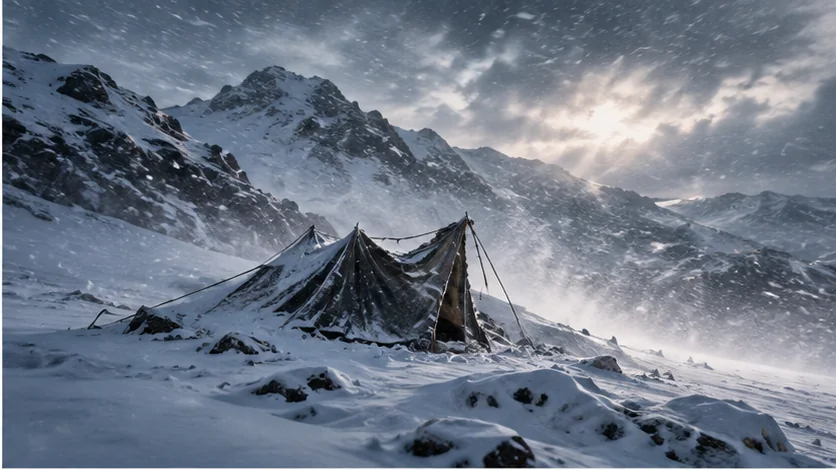
Images are powerful in true-crime and unexplained-incident coverage, especially when the original location appears bleak or frightening. An archival photograph from the expedition, if lawfully used, is a historical document with a date and source. A present-day mountain photograph shows geography under different conditions. A generated illustration can communicate weather, isolation and a possible campsite appearance but is not evidence of the 1959 event. Those distinctions should be visible in captions. WNV's accompanying image is an AI illustration, not a recovered photograph of the campsite and not a frame from a reconstruction verified by investigators. Atmosphere should never be mistaken for factual documentation.
What remains valuable for readers today
The Dyatlov Pass story connects practical mountain safety, the physics of snow, the limits of forensic reconstruction and the way cultural myths spread. Readers do not need to accept a paranormal explanation to understand why the case attracted global attention. It illustrates that small variations in terrain and weather can have serious consequences, and that some evidence may be altered by the passage of time before searchers arrive. It also shows why a convincing explanation can take decades: researchers need new tools, comparisons and an honest willingness to reexamine assumptions. The human cost should remain central rather than being lost beneath competing viral theories.
Frequently asked questions
How many people died at Dyatlov Pass?
Nine members of the expedition died during the 1959 tragedy in the northern Ural Mountains. The widely cited scientific research examines the circumstances of those deaths rather than treating the victims as fictional horror characters. Their identities and the historical record deserve respect.
Did scientists prove an avalanche definitely happened?
The published studies describe a physically plausible slab-avalanche mechanism and later evidence that avalanches occur in the area. That supports the hypothesis, but the research does not provide direct footage or eyewitness confirmation of the exact 1959 sequence.
Why was the avalanche theory controversial?
The apparent slope angle, lack of obvious avalanche evidence when rescuers arrived, uncertainty over timing and unusual injuries all created difficulties. Researchers tried to address those difficulties rather than dismissing them.
Are supernatural explanations supported by comparable evidence?
The cited peer-reviewed work supplies no demonstration of a supernatural cause. Many sensational versions of the story go beyond the available record. A reader should demand independent, specific evidence before adopting an extraordinary explanation.
Are the images in this article historical photographs?
The hero image is labeled as an AI-generated editorial illustration. It is not evidence, an archival photograph or an accurate reconstruction of events witnessed in 1959. The linked scientific articles provide research sources for evaluating the story.
Sources and verification
Read the original sources to examine the evidence and publication dates.
Related coverage
 AI illustration
D.B. Cooper: the FBI evidence behind America’s 1971 unsolved skyjacking
An evidence-first investigation of the real 1971 D.B. Cooper skyjacking, FBI records, the suspects, the vanished ransom and what remains unknown.
 AI illustration
Antarctic sea ice at third-lowest winter maximum: NASA’s 2026 numbers explained
NASA’s October 12 data show Antarctic winter sea-ice extent peaked at about 17.59 million km² in September 2026. What it means and what it does not.
 AI illustration
India’s September inflation reaches 5.54%: food prices and RBI outlook explained
The September 2026 retail inflation rate of 5.54% and food inflation of 7.74% raise questions about household costs and the RBI’s future rate decisions.